OIL FEVER!
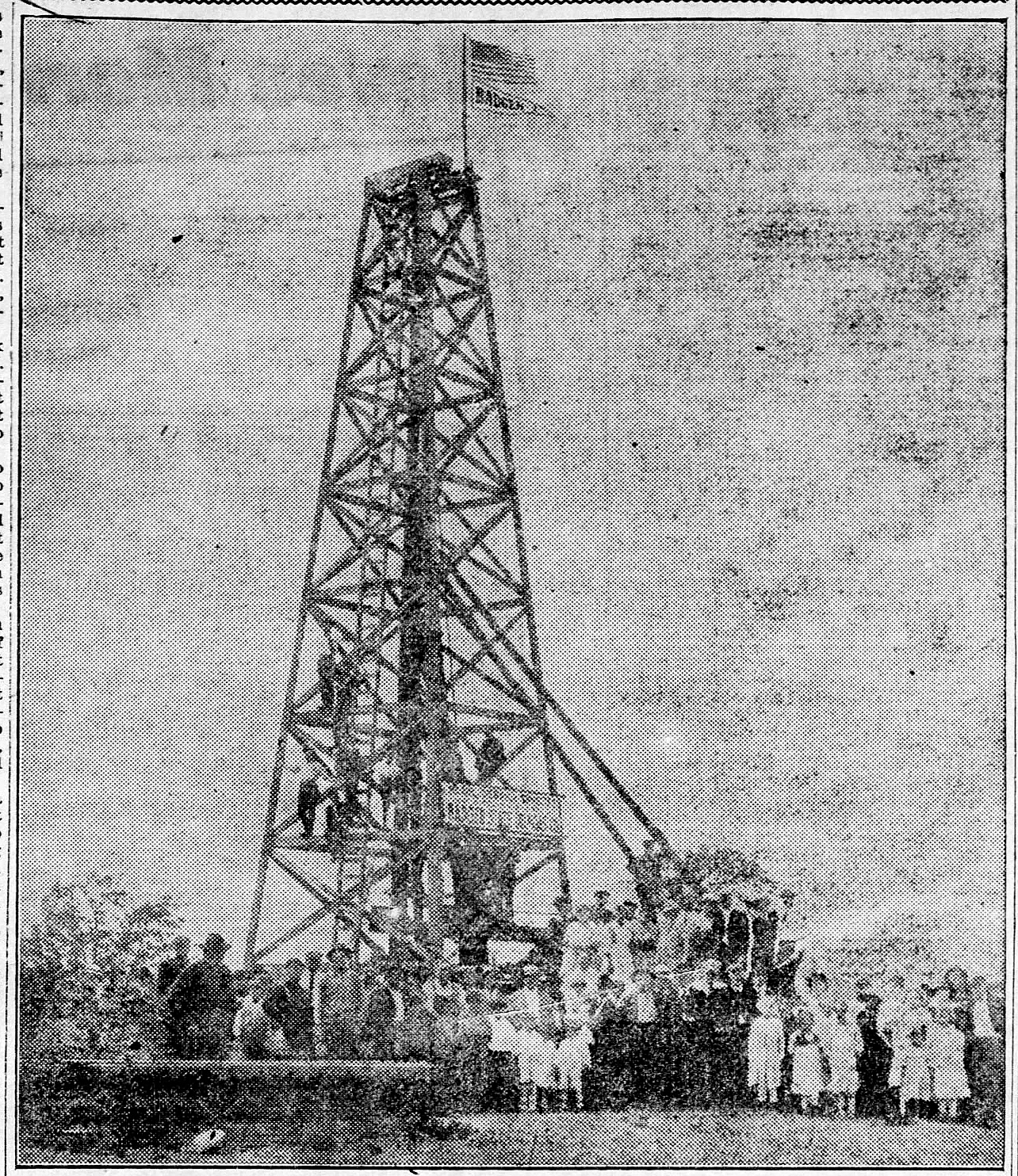
MAY 1919: The J. J. Faust Co. of South Kaukauna was digging a new water well for Henry Fassbender’s White Clover Creamery in Hollandtown, Brown, Wisconsin. Reaching a depth of 250 feet, the drill became fastened in the rock, and could go no further. Moving a few feet away, they started to drill a new well. As the drill moved downward, reaching 230 feet, and again at 280 feet, they discovered what appeared to be oil coming up with the water.1 The oil was so plentiful that “by skimming, a sufficient amount of oil was secured to run Fassbender’s motor.”
JULY 1919: By the 18th the well had reached a depth of 430 feet, and Frank Wheeler of Appleton’s Keystone Oil Company had visited the site to get a sample of the oil for testing.2 While drilling to this depth, they moved through shale strata of about 250 feet, and a limestone strata of 210 feet.3
NOVEMBER 1919: Henry M. Johnson, president of the commercial Engraving Co., Sheboygan, Sheboygan, Wisconsin, was in Kaukauna on business, and heard of the discovery. He immediately drove to Hollandtown to see for himself. “Being familiar with the oil business,” he, too, sent the oil to be tested and it was determined to be of very high quality. Oil so rich that “it has been pronounced by experts to compare favorably with the highest quality ever found in the United States.4 The Wisconsin chemists in Madison graded the oil at 43%, the “highest grade known for oil as yet discovered in this country. One barrel of Hollandtown oil is thus equivalent to five barrels of the best oil found in Oklahoma.”5
While Henry Fassbender worried about his spoiled water well, oil fever struck Kaukauna. Over the next six months, Henry Johnson personally leased 5,000 acres of farm land in Brown County, incorporated the Badger State Oil and Gas Company for $500,000.00, and made arrangements for the first Wisconsin oil derrick to be constructed.6
APRIL 1920: As the cold winter started to thaw in the warmer April temperatures, the roads around Hollandtown were in such poor condition that it was “hard snakin’.” Oil fever was ramping up as Henry Johnson expected to “resume operations at the Fassbender property about May 1st.”7 Johnson began taking bids for putting “down a well of 4,500 feet depth close to the location where the oil in two other wells of a depth of 500 feet has been discovered.”8
JUNE 1920: The derrick contract was awarded to contractor Albert Lucklow, and the Kaukauna Manufacturing Company began construction on June 20th. When completed, the oil derrick was 16 feet across the bottom, with five feet at the top, and extended 60 feet into the air.
Needing investors, the Badger State Oil and Gas Company took out full-page ads in all the major Wisconsin newspapers. Interested parties could also receive “some valuable information by calling at the Van Able Bros.”9 Johnson was not only looking for investors, he was looking for land. Convinced that oil would be discovered in paying quantities, he approached the people of Hollandtown. It was reported on June 3rd that he had “leased upwards of 9,000 acres,”10 all of which was still under cultivation. Not everyone was convinced that there was oil in Hollandtown, as “one man refused $5,000 for two acres of land across the road from the White Clover Creamery.11
JULY 1920: The first plunge of the drill was to occur on July 1st as part of a three-day celebration. “Chemical analyses have shown that this oil had graded equal to the best Oklahoma oil and as the ledge in which it has been found runs northwest and adjacent to this city it can easily be imagined what a bright industrial future Kaukauna will have if the Badger State company realizes its expectations. So if you want to be able to tell your grandchildren about how the first oil well was started in Wisconsin you had better crank up your auto, hitch up your horse, or beg a ride from some friend and go to Hollandtown, six miles from this city, on next Thursday afternoon.”12
LIFE GOES ON
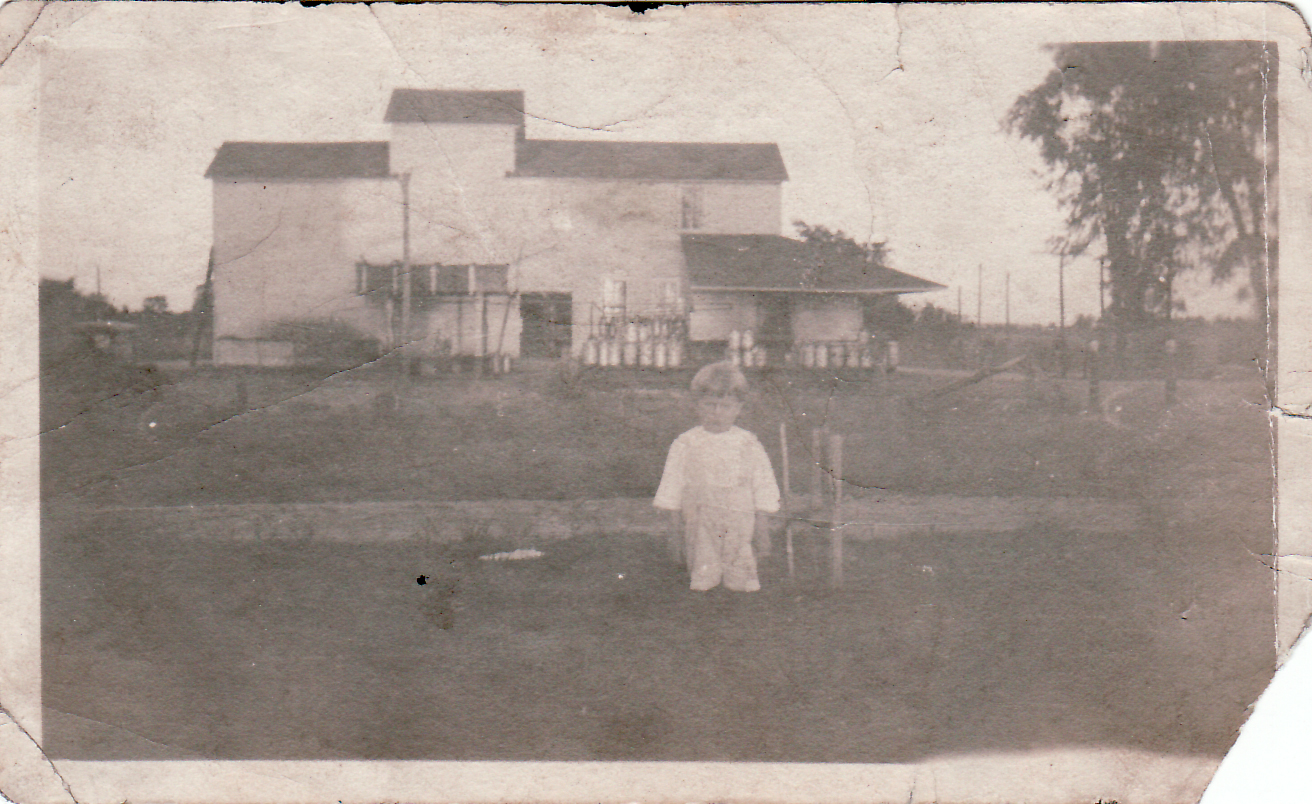
The editor of The Kaukauna Times had this to say about Henry on November 20, 1919: “The Times having heard the tales of oil discoveries at the White Clover Creamery at Hollandtown expected that the proprietor, Mr. H. J. Fassbender, like Aladdin Nights, would be found gazing down into the murky depths of his oil well. Which proved that The Times really was not well acquainted with Mr. Fassbender who does not propose to lose the bird in his hand for the sake of the one in the bush, or neglect his creamery for his oil well.”13
At the time that he struck oil, Henry was taking in 12,000 pounds of milk per day, and 30,000 in the “flush season.” With this growth in his business, he was in the process of planning an 18’ x 46’ addition to the factory, which, when completed, would hold two new vats for cheese, and a pasteurizer. With a total of four vats, he would double his capacity, being able to produce up to 16,000 pounds of cheese per day.14 One can almost hear his wife, Ida, say: “Ack, Henry! We don’t know if there really is oil down there, but we do know that the farmers will be bringing 50,000 pounds of milk a day to you this spring.15 We must finish the building!”
MARCH 1920: For the 1920 season, Henry contracted Martin Williams to drive Truck No. 4. It was expected that he would be hauling 8,000 pounds of milk per day during the “rush season.”16 Ben Vande Yacht was to drive Truck No. 3.
APRIL 1920: It was reported on April 22nd that Henry had just received a new 10,000-pound milk vat. Another vat was still on order, but had not yet been delivered “owing to the railroad strike.”17
MAY 1920: On May 6th, it was reported: “A new water pressure system has been installed in the White Clover Creamery which with the 1000 barrel tank, will greatly facilitate operations. It is said that with the aid of this new system, a stream of water can be thrown as high as a church steeple, provided the steeple is not as high as the Washington monument.”18
SMALLPOX. “The home of Henry Fassbender is quarantined for smallpox, none of the cases are very serious.”19
JUNE 1920: The annual Schut was held on June 8th. “Twas on a bright June morning, in fact on Tuesday of this week, that a postmaster, just an ordinary postmaster, fared forth from our city [Kaukauna] in a Ford coupe and at even-tide he returned to his home a king, crowned with glory and honor…” And in these words, The Kaukuana Times began the article telling of John Coppes being crowned King of the 1920 Schut.20
On June 28th, a big thunderstorm moved through Hollandtown. The storm forced nearly 100 gallons of crude oil to the surface of the well.21 While Henry was able to run his engines on the crude that was coming out of the three wells already dug on his property, the contamination of the water supply was making running the creamery difficult. The thunderstorm “seemed to force the oil stronger than ever at the White Clover oil well. Tuesday morning the water was unfit for use, the employes at the creamery were unable to use the water for washing or scrubbing and it was impossible to drink at all. It was only after several hours of pumping that the oil was thinned down to use for scrubbing purposes and then it was a light yellow color…”22
WHICH BRINGS US TO THURSDAY, JULY 1, 1920
“The dedication ceremonies last Thursday afternoon were opened by an address made by Judge Andrew Gilbertson treasurer of the [Badger Oil and Gas] company, who introduced Mayor Raught of this city [Kaukauna], who delivered a felicitous speech and was followed by Postmaster John Coppes.” When the 1,500-pound drill was set in motion by the J. J. Faust Company, over one hundred people had descended upon Hollandtown to witness its first plunge.
“The first bore is being made with a fourteen-inch drill to a depth of fifty feet. The drill struck rock at the thirteen-foot depth, which is expected to continue to the 1200-foot stage when granite will be encountered and blasting will be resorted to until the shell is pierced and the oil, should there be an oil pocket, will gush forth. The drill will be changed to a twelve-inch drill after the fifty-foot level is reached and continued to the 300-foot level. Iron pipe casing will be inserted as they go along. From the 300-foot level drilling will be carried on with an eight-inch drill. The first day five or six feet of the bore was drilled, and this will be continued at a rate of rom 7 to 8 feet until the fifty foot level is reached. From then on it is expected that from six to seven feet will be drilled each day until granite is reached…”23
Three men were put in charge of the large steam rig, which was “connected to the tower to work the drill and to insert the casing in place as progress is made in the downward course.” These men worked “from ten to twelve hours each day, Sunday excepted.”24 Due to the long hours, the men wished to find a “nice cozy little place to eat and sleep” in Hollandtown. Not finding a home for sale or rent, they reportedly “decided to make a two compartment dwelling out of the oil derrick.”25
AUGUST 1920: On August 11th, it was reported that the drill had reached a depth of 325 feet, and a night crew had been added so the drill was now being operated both day and night. The drill site continued to draw a large crowd of visitors, many traveling from Oklahoma and Texas to view the operation.26
Imagine the constant noise! The exact location of the derrick is not known. Still, it was in very close proximity to the Fassbender home, and with six children at home: Harold (13), Laurine (11), Norbert (9), Bernard (7), Mildred (5), and Hubert, who was almost three, the constant noise must have driven Ida insane.
NOVEMBER 1920: On November 30th, The Kaukauna Times “Hollandtown” news column reported: “Our oil well which had been the hope of so many thrifty investors seems to be a dead issue at present. It makes Hollandtown rather lonesome, especially at night to see the lofty oil derrick standing like the ruins of Pompeii. Why not use it for a wireless station?”27
Proving that Henry was determined to go on with “life as usual” was confirmed in the same Hollandtown news column, where it was reported: “J. W. Montgomery and Co., our local painters and decorators have just finished painting the interior of the White Clover Creamery. The painters intend to paint the building white inside and outside, and the owners intends to keep on using his patrons white.”28
DECEMBER 1920: Hollandtown News dated December 10th: “A new power plant is being installed at the White Clover creamery. It is hoped by the correspondent that this new motor will be in good running order at all time.”29
FEBRUARY 1921: “Hollandtown News dated February 10: “The annual meeting of the White Clover Creamery was held last Thursday afternoon. The patrons have resolved that in the future the truck drivers will not be obliged to haul such articles as tomatoes or fancy candies. The driver of truck No. 3 [Ben Vande Yacht] will please take notice.”30
MARCH 1921: Hollandtown News dated March 10: “It seems as though our oil well is not a dead issue as yet. Several oil prospectors from Texas and other points in the south have been here during the past week.”31
MAY 1921 – Hollandtown News May 12th (Received too late for last week)
“During a recent thunder storm the oil derrick at Hollandtown was wrecked shattering all hopes of investors…
…The White Clover Creamery at Hollandtown is received upwards of 40,000 pounds of milk daily. It is expected that this will be a record season in spite of the hard competition…”32
SOURCES
- “Oil On Farm Near Menasha,” The Menasha Record, 3 July 1919, Thursday, p. 3, col. 3; digital images, Newspapers.com (www.newspapers.com : accessed 9 October 2025). ↩︎
- “Additional Personal,” Appleton Post-Crescent, 7 July 1919, Monday, p. 2, col. 4; digital images, Newspapers.com (www.newspapers.com : accessed 9 October 2019). ↩︎
- “Well Diggers Strike Oil in South End of Brown County,” The Green Bay Gazette, 18 July 1919, Friday Evening, p. 1, col. 4; digital images, Newspapers.com (www.newspapers.com : accessed 20 November 2015). ↩︎
- “Pictures Showing Scene at Hollandtown When Drilling on First Oil Well Was Launched; Henry Johnson on the Job,” The Sheboygan Press, 13 July 1920, Tuesday, p. 7, col. 2; digital images, Newspapers.com (www.newspapers.com : accessed 18 Nov 2018 ). ↩︎
- “High Grade Oil Found,” The Kaukauna Times, 20 November 1919, Thursday. ↩︎
- “Starting Activities in the Badger Oil and Gas Field,” The Kaukauna Times, 8 July 1920, Thursday, p. 1. ↩︎
- “Hollandtown,” The Kaukauna Times, 1 April 1920, Thursday. ↩︎
- “To Drill For Oil at Hollandtown,” The Kaukauna Times, 22 April 1920, Thursday, p. 1. ↩︎
- “Hollandtown,” The Kaukauna Times, 13 May 1920, Thursday. ↩︎
- “Hollandtown,” The Kaukauna Times, 3 June 1920, Thursday. ↩︎
- “High Grade Oil Found,” The Kaukauna Times, 13 November 1919, Thursday. ↩︎
- “Kaukauna May Become an Important Oil Center,” The Kaukauna Times, 24 June 1920, Thursday, p. 1. ↩︎
- “Editorial,” The Kaukauna Times, 20 Nov 1919, Thursday. ↩︎
- “White Clover Creamery,” The Kaukauna Times, 20 November 1919, Thursday, p. 1. ↩︎
- “Hollandtown,” The Kaukauna Times, 11 March 1920, Thursday. ↩︎
- Ibid. ↩︎
- “Hollandtown,” The Kaukauna Times, 22 April 1920, Thursday. ↩︎
- “New Pressure System,” Hollandtown, The Kaukauna Times, 6 May 1920, Thursday. ↩︎
- “Hollandtown,” The Kaukauna Times, 13 May 1920, Thursday. ↩︎
- “Hollandtown Schut Draws A Big Crowd,” The Kaukauna Times, 10 Jun 1920, Thursday, p. 1, col. 1. ↩︎
- “Kaukauna May Become an Important Oil Center,” The Kaukauna Times, 24 June 1920, Thursday, p. 1. ↩︎
- “Hollandtown,” The Kaukauna Times, 1 Jul 1920, Thursday. ↩︎
- Pictures Showing Scene at Hollandtown When Drilling on First Oil Well Was Launched; Henry Johnson on the Job,” The Sheboygan Press, 13 July 1920, Tuesday, p. 7, col. 2; digital images, Newspapers.com (www.newspapers.com : accessed 18 Nov 2018 ). ↩︎
- Ibid. ↩︎
- “Hollandtown,” The Kaukauna Times, 22 July 1920, Thursday. ↩︎
- “Oil At Kaukauna,” The Cedarburg News, 11 August 1920, Wednesday, p. 1, col. 5; digital images, Newspapers.com (www.newspapers.com : accessed 31 October 2025). ↩︎
- “News From Outagamie County and Wisconsin,” Appleton Post-Crescent, 22 July 1920, Thursday, p. 7, col. 4; digital images, Newspapers.com (www.newspapers.com : accessed 27 July 2018). ↩︎
- “Hollandtown,” The Kaukauna Times, 30 November 1920, Thursday. ↩︎
- “Hollandtown,” The Kaukauna Times, 10 December 1920, Thursday. ↩︎
- “Hollandtown,” The Kaukauna Times, 10 Feb 1921, Thursday. ↩︎
- “Hollandtown,” The Kaukauna Times, 10 Mar 1921, Thursday. ↩︎
- “Holland-Dundas,” The Kaukauna Times, 12 May 1921, Thursday. ↩︎
